January 29, 2026
The Early Intervention Process for Babies: What to Watch For, When to Act, and How To Advocate

Some of the links on this page may be affiliate links. That means, I get a small commission if you purchase through this link. However I make it a point to only share items that I truly love, use, or check all my boxes!
What is Early Intervention (And Why Should Parents Care About It)?
There are many things we know to be true about infant and child development, and one of the biggest is that the first 3 years of life are one of the most pivotal periods of development for our children, with the power to shape the trajectory of their lives and lay foundations that will support a lifetime of success. Hence, the development of Early Intervention (EI) Programs.
Early Intervention (within the United States) refers to publicly funded programs for children from birth to 3 years of age to support all types of developmental delays, diagnoses, or disabilities at free or low-cost. Services within Early Intervention can include therapies like physical, occupational and speech therapies, special education and vision services, family training and more – all with the primary goal of supporting the child’s development and their ability to participate within their everyday routines and family units to their full potential.
While an evaluation is required to determine eligibility for the program (more on this below), Early Intervention Programs are designed to support infants and toddlers with diagnosed disabilities, developmental delays, or diagnoses and conditions that put them at a higher risk for developmental delay than their peers.
Families who qualify for the program typically end up with a team of professionals consisting of case managers, coordinators, therapists and teachers, who will work directly with the child and family to support skill building and participation in their daily routines.

Answers to Common Questions Parents Have About Early Intervention
How do I start the process of getting an evaluation, especially if my pediatrician is recommending we ‘wait and see’?”
See the ‘Step by Step’ section below!
“What signs should I look for to know my child may need an evaluation? How do I start advocating with my child’s pediatrician or care team if they’re recommending we ‘wait and see’?”
If you’ve found yourself wondering if your baby is delayed and what to do if they’re not meeting milestones, especially if you’re feeling dismissed, this is for you!
Let’s unpack this a little, because it’s a complex issue and I KNOW firsthand how anxiety-inducing milestones can be. First, please know that really & truly, development is variable. Timelines and ranges are truly that, because they may look a little different for every baby, and that’s okay!
Generally speaking, I recommend following the two-month rule. That means if a milestone is expected at say 6 months (like sitting and rolling back to belly/belly to back) if that milestone doesn’t seem like it’s coming within two months from that expected month (so around the 8-month mark), I would recommend speaking with your pediatrician about a physical therapy assessment. The reason the two-month rule is my recommendation is that SO many ministones & milestones happen so quickly in the first year of life.
Each milestone builds quickly on the last, and two months is a fair amount of time to accommodate for completely normal variations and timelines in development, while not letting so much time pass that your little one falls behind.
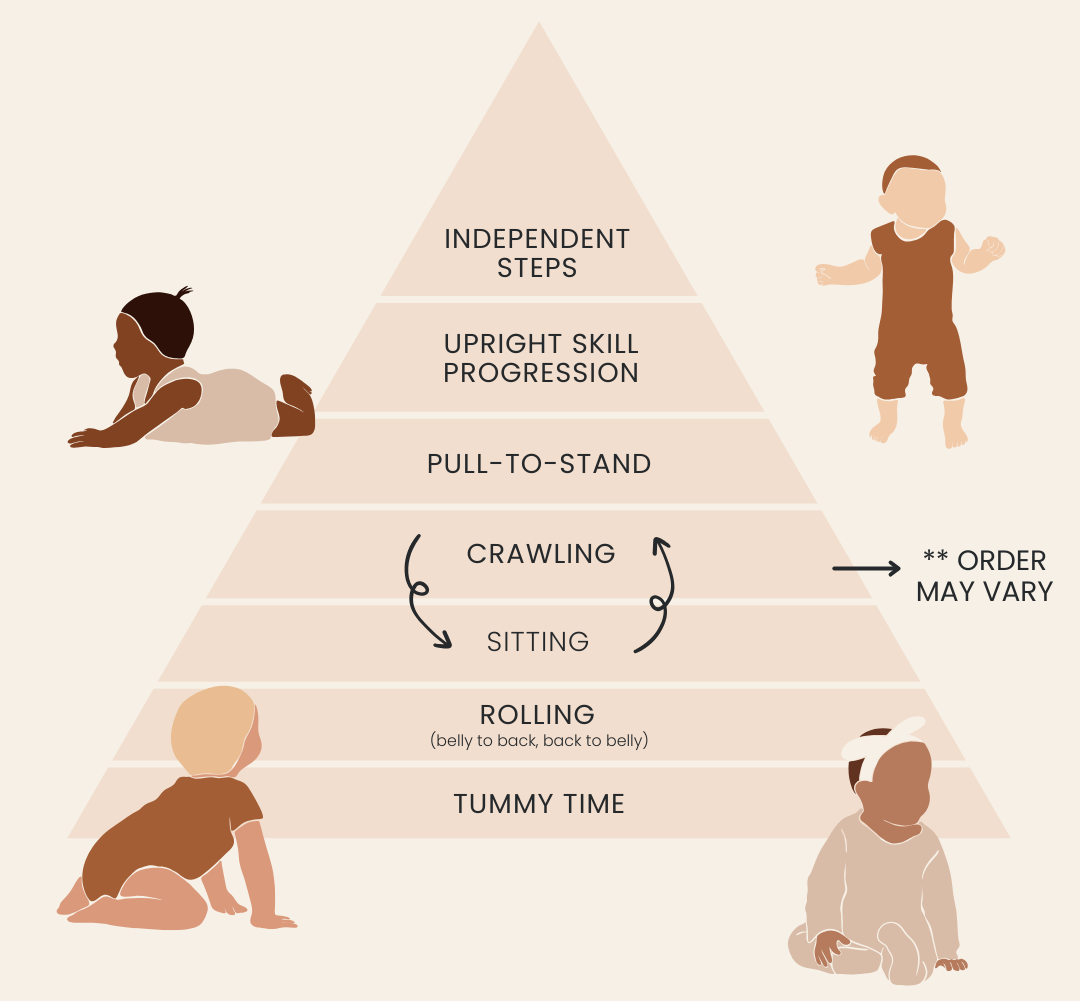
While this is not an all encompassing list, a recap of the ‘Two-Month Rule’ for gross motor milestones can be found below as a general guideline to help! But remember, any concerns you have about your child’s development are worth bringing to your pediatrician’s attention!
-
Tummy Time: Baby still resisting tummy time after 3-4 months, including not yet beginning to lift head or press into forearms/hands.
-
Rolling: Not rolling both ways (belly <> back, back <> belly) by 7 months and not showing signs of ministones.
-
Sitting: Unable to sit at least briefly when placed by 8 months.
-
Crawling: No crawling or progress through crawling ministones (ie: army crawling, pivoting belly down, brief periods of hands and knees, rocking or planking on hands and knees, transitioning in/out of sitting) by 10 months.
-
Standing/Walking: No pulling to stand or progress through pre-walking ministones (cruising, balancing in standing, rising in/out of standing, etc) by 12 months.
More ‘yellow flags’ in development that may indicate keeping a closer eye can also be found here.
For resources and support specific to each milestone, from tummy through walking, check out our Mastering Milestones courses.
“What happens if my baby doesn’t qualify for services but I still have concerns? Will I be taken seriously if my baby’s delay is ‘mild’?”
If your baby doesn’t qualify for services but you still have concerns, you can always request a repeat evaluation. Though there may be limitations on how quickly a repeat can be done, contacting the same number you originally did is a great starting point to understand those guidelines more.
And whether your child qualifies or not, has mild versus more severe delays, or falls somewhere in the middle- the entire goal & underlying purpose of the EI program’s is to help support children & their development so the entire family unit can thrive. This includes during the evaluation process, which is designed to catch even the most subtle signs and any concerns, no matter how big or small they may be. And again, the positive of EI evaluations is that even if your little one DOESN’T qualify, we will still give you lots of tips & tricks that will help encourage certain aspects of their development – so that is definitely a win win!

Advocating with Your Pediatrician/Care Team
Here’s the thing…As a parent who had a child in EI AND preschool services, please hear me that I know how it feels to be brushed off about concerns you have or that nagging feeling in your gut. I know how it feels to worry you’re over analyzing, I know how it feels to be told to ‘just give them some time’.
Please know that whether you are being taken seriously or not, you deserve to have your worries be heard, validated, and assessed. Pediatricians are INCREDIBLE and know so much about so many aspects of development (obviously!), and this is not meant to be a dig at them. However, remember that there are experts in each developmental domain and area of medicine/healthcare for a reason. There is simply too many important facets for one person to be an expert in every single one. And YOU are the expert on your child. In many cases, an assessment performed by a specific expert in that area can reveal even subtle signs that warrant monitoring or intervention. And again, even if they don’t qualify, you’ll walk away with specified activities and exercises to help YOUR little one advance. And if they do qualify, you’ll get the individualized care to help your little one (and you) succeed! No harm, no foul!
NOW – what if you’re continuing to get push back on a referral? Remember, the vast majority of counties in the US do not require a pediatrician (or any doctor) referral to schedule an evaluation. You can find more on the self-referral process below!
As a general suggestion, it can be helpful in advocating (& in preparing for the evaluation!) to bring:
-
Videos or pictures of movement or other concerns you’re noticing that your child may not demonstrate in a brief well visit
-
Any and all of your specific concerns. Keeping a running list or note in your phone can be a helpful way to jot things down & stay organized.
-
Any previous assessment results (whether through early intervention or private providers)
Remember….You’re not being overprotective, you’re being proactive. And that can make ALL the difference for your little one!
Your Step-by-Step Guide to Starting the Early Intervention Process
Step 1: Look up your state/county’s EI contact here.
Step 2: Call the appropriate contact number & be sure to ask the following two questions; (1) As a concerned parent, can you self refer for an EI evaluation, or is a physician referral required? (2) Is there any cost associated with the evaluation or services if your child qualifies?
Step 3: Determine next steps for paperwork and beginning the process to schedule the evaluation. (What to expect, timeline expectations, when to follow up, etc.)
Step 4: Schedule & have the evaluation completed & next steps determined by the care team.
-
If your child qualifies, what’s next?
-
If your child didn’t qualify, what are the recommendations for supporting their development at home and monitoring progress to determine if/when a repeat evaluation would be warranted if concerns continue or advance.

What to Expect During An Evaluation, Qualifying for the Program & Tips for Preparing Before The Big Day
Before the Evaluation:
Having videos or pictures of movement and any concerns you have that your child may not demonstrate during the evaluation can be immensely helpful for evaluators, especially in the event they do not qualify via standardized testing and you are in a state that allows qualifying for the program based on something called informed clinical opinion. More on that below.
-
Pro Tip – it can be helpful to store them all in a special folder or album for easy access during the evaluation!
-
Keep a running list of any and all of your specific concerns. No concern is too small. I suggest having them in a note or list on your phone so you can quickly jot things down in the moment & stay organized.
-
Have any previous assessment results (through EI or private providers) on hand. You may know the information inside & out, but it can be so common to forget details in the moment and having those results on hand to grab & look through can be immensely helpful for parents AND the evaluators.
What to Expect During the Evaluation & How Qualifying Works:
*Disclaimer: I have only worked in the NYS EI program, and variations in this process between states (and even counties within the same state) are present and worth considering. The following information is from my experience being an EI evaluator and provider within NYS specifically, but please know it may vary for you depending on location.
In NYS, an initial evaluation to determine eligibility for the EI program involve what’s called a Multidisciplinary Evaluation (MDE). This means a team of two evaluators will be present, one of which is an expert in the primary area of concern, and one of which is either a special education teacher if there is only one area of concern, OR an expert from another discipline specific to any secondary concerns, if present.
A full background, developmental & medical history will be taken (pregnancy, birth history, any/all medical information), including a thorough discussion of parent concerns. Parent report, evaluator observations and standardized testing are all considerations within the evaluation process.
Standardized testing is performed for all domains of development (not just the ones of concern!), including cognitive, adaptive, gross & fine motor, communication, and social-emotional. Scores are then reported and discussed with parents. In NYS, a standardized test called the DAY-C 2 is typically administered for this, with qualifying scores including; a standard score of 78 or below in two or more developmental areas OR a 70 or below in one developmental area.
In NYS, a child can also qualify for the EI program if they have an automatic qualifying diagnosis or via something called informed clinical opinion (ICO). ICO can be used when standardized testing is not capturing evaluator concerns, as standardized testing typically only looks at ‘can a child do a skill or can they not’ over important considerations like quality of movement and asymmetries or compensations in movement present. The use of ICO must be justified thoroughly and indicates an overall 33% delay in a specific domain.
Regardless of whether a child qualifies or not, all test results are discussed with parents at the end of the evaluation, including service recommendations of the evaluators. Evaluations are then completed and sent to the County and initial service coordinator for each child’s individual case, and final eligibility determination along with what services will be provided (frequency and duration) is had. If a child qualifies, an Individualized Family Service Plan (IFSP) will be developed with the family and team, which contains the child’s goals for a 6 month period, at which time goals are reviewed and revised depending on progress.
Overall, know that your evaluators are there to help you AND your child – we care, we want to hear it all, and we want to help support your entire family. We’re here for you!

A Final Word of Encouragement – because you deserve to be heard, and your baby deserves support!
Second guessing ourselves as parents can be such a real part of navigating raising our little ones, trust me, I get it! But truly, at the end of the day – you know your child best. You know you can trust that feeling in your gut or niggling at the back of your mind that something may deserve a closer look. It’s ok to trust that. It’s ok to advocate. You’re doing a great job, and your child is lucky to have you AND your support, every roll, crawl and step of the way.
And if you’re navigating waiting for an evaluation or services to begin, provider shortages, or your child didn’t qualify but you’re still concerned – I have a resource that can help put the power back in your hands. My Milestone Playbook breaks down the key milestones to expect in the first 3 years of life, including when to expect them and how to support each and every skill with simple, play-based activities and without the overwhelm. You can check it out right here, and I truly hope this all helps in some small way – don’t hesitate to reach out with any questions you have, the M&M team is here to help!
Was this helpful? Share it with a friend or save it for later!