
Early Rolling, Body Tension, Reflux & Torticollis: What’s the Connection?
Is Early Rolling in Babies a Sign of Body Tension, Reflux, or Torticollis?
One of the most common questions I get is related to when baby begins rolling earlier than expected (generally before 5-7 weeks of age) and whether that indicates tension within their body, so let’s talk about it!
Belly to Back Rolling Early (Before 5–7 Weeks)…What Does It Mean?
First, let’s start with belly to back rolling, which is expected around 3-5 months of age, but can happen earlier due to the weight of their head and the muscles on the front of their body being just a bit weaker than the muscles on the back of their body. This is primarily due to in utero positioning, which preps the back muscles to fire first during tummy time!
When baby begins to roll belly to back earlier than ~5-7 weeks of age, it is often related to either tension within their body, GI discomfort, or the influence of reflux/silent reflux. Essentially, they are completing the belly to back roll by arching and extending to ‘get away’ from the discomfort they’re feeling. It is often not an intentional, well controlled roll, and it will often go away briefly and return as a more intentional roll as they work towards mastering the milestone in coming months.

Back to Belly Rolling Early…Is It the Same Thing?
Back to belly rolling, however, expected between 4-6 months of age, is not quite the same! An early back to belly roll can absolutely be related to body tension or arching of the neck/upper back, but more often seeing an earlier roll from back to side or back to belly is related to residual ‘newborn curl’ (aka the in utero position!). That newborn curl will go away as baby does tummy time and plays freely on the floor, preparing their body for a more intentional, consistent & purposeful roll in coming months.
How to Encourage Flexion and Support Intentional Rolling Milestones
Regardless of why you may be seeing your little one arching, extending, or rolling earlier than expected, here are some simply ways to start encouraging flexion and intentional master of rolling ministones (the little skills that lay the foundation for the big skill to happen!) AND the big rolling milestones.
Pro Tip: These tips can also be helpful for other times they’re forcefully extending, like fighting getting into their car seats & resorting to the alligator roll with diaper changes (IYKYK!).
When a child is struggling with arching, extending, or flinging themselves back in sitting- that is essentially the back/extensor muscles firing MORE than the front/flexor muscles.
When you’re noticing this, the key is to position them in a way that encourages more flexion and keeps them away from the "tipping point" that can often contribute to overactivity of the extensor muscles.

Option 1: One-Leg Bent Carry to Reduce Extension and Improve Body Control
When carrying them, gently bend ONE leg up and hold it there. When both legs are extended forcefully together, it not only helps them generate more force to continue extending, but it also communicates to their brain that the legs are ONE unit (which is not what we want!). Bending one leg up and gently holding it helps not only break up that forceful extension pattern, but it is also helps them begin to understand how to dissociate their limbs from each other…aka move them separately. Being able to move legs separately is required for almost all higher level skills - think crawling, pulling to stand through a half kneel, taking steps & beyond!
The one leg bent position is also awesome in general for any sort of belly discomfort, as the gentle pressure on the belly and movement of the leg helps keep everything moving through the GI system.
Option 2: Using a Towel Roll to Encourage Flexion and Rolling Skills
When baby is laying on their back, positioning a towel roll underneath them like shown in this video can be a really helpful way to encourage more flexion of their body and help keep them away from that ‘tipping point’. You can even turn this into a little game of ‘rocking & rolling’, which can be so helpful in showing them not only what muscles to activate, but also encouraging them that they’re not stuck.
Option 3: Preventing the “Tipping Point” in Sitting to Reduce Arching
If baby is extending & throwing themselves backwards in a sitting position, aim to keep them tipped slightly forward with toys placed at eye level or below. Encouraging them to gently prop on hands in front of them can be helpful as well. Keeping them tipped slightly forward with vision (if available to them) drawn downward not only helps encourage more flexion through their body, but also helps keep them away from that 90* hip angle ‘tipping point’. Once baby’s hips are at a greater than 90* angle to their trunk (aka the tipping point), it can be extremely difficult for them to recover and avoid extending backwards because those overactive back muscles are now in the perfect position to turn on & overpower the front flexor muscles that aren’t quite strong enough to counter them yet.
Overall, when you're trying to combat extension, getting them into positions that better encourage the muscles along the front of their body (flexor muscles) to activate & strengthen is a huge goal!

The Connection Between Reflux, Arching, and Torticollis in Babies
Now…what about when baby is really struggling with reflux, arching AND torticollis?
REFLUX IS SO HARD. If you’re up against reflux with your little one, please know you’re doing a great job and it truly will get better. In the interim, here are some ways to help support your little one and their milestones.
As discussed above, reflux can absolutely be a big contributing factor to why a baby may be arching their back or extending their body. With reflux or any sort of belly discomfort, it’s absolutely common to see arching of their back frequently, often related to trying to 'get away' from that discomfort. Tummy time is one of the most prominent positions that arching shows up in (which as mentioned above, can contribute to that earlier than ideal roll!), but what’s the connection with torticollis?
Torticollis often also goes hand in hand with reflux/belly discomfort, and in turn, lots of extending/arching. The theory behind that connection is that the primary muscle that's involved in torticollis (the sternocleidomastoid muscle), which is responsible for tilting your head in one direction and rotating it in the opposite, is ALSO is close in proximity to the vagus nerve, which controls rest and digestion amongst many other important functions. When the SCM muscle is tight (and thus overactive), it can create over activity and atypical signs to that nerve as well. This can potentially contribute to reflux symptoms and belly discomfort, as the input baby’s nervous system is getting is much more ‘fight or flight’ than ‘rest & digest’. Wild, right?!
So What Can We Do About Reflux?
How Reflux Affects Baby Development and Rolling Milestones
When it comes to reflux, it may seem counterintuitive, but the stronger baby gets through floor time and free movement, the quicker reflux will improve. This is because the esophageal sphincter, which is responsible for stopping the stomach contents from coming back up into the esophagus, is actually muscular in nature, and muscles grow & strengthen by working! This is also why the majority of reflux cases typically resolve by around 1 year of age- baby is more mobile, stronger, and so is that sphincter. But how are you supposed to realistically support free movement on the floor and tummy time if every time you lay them down, they immediately spit up or cry?!?! I got you!
Tummy Time Tips for Babies with Reflux
When it comes to tummy time, the ultimate goal is to be tolerating increasing periods of being flat on the floor by around 10-12 weeks of age. But when that just doesn’t feel possible, here are some quick tips that may help build tolerance to floor time and reduce the discomfort they’re feeling:
Elevated back play on your legs or a pillow
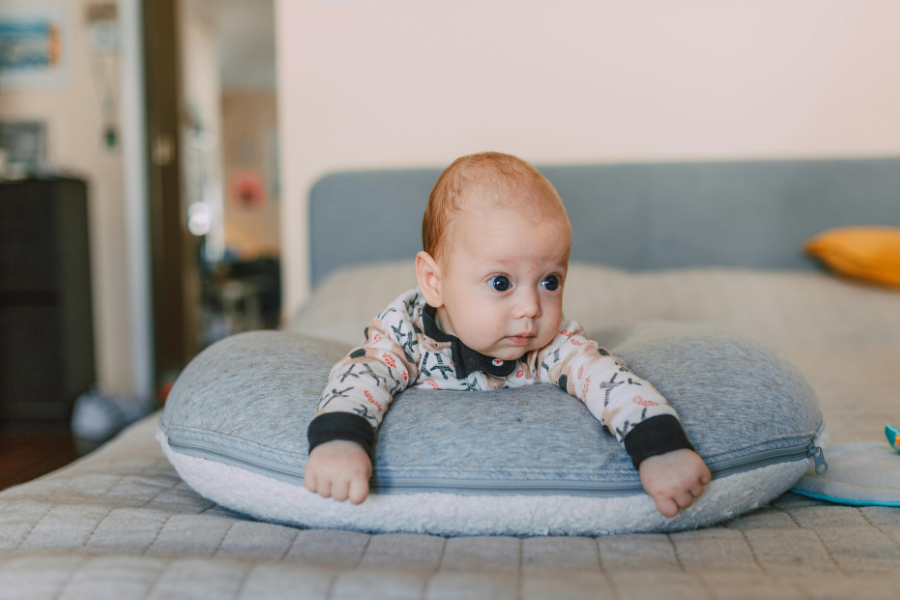
Elevated tummy time- over legs (easy to play with the angle for increasing or decreasing difficulty- with knees MORE bent, it's easier for baby because they have a smaller range of motion to lift against gravity!) This can also be done over a boppy, couch cushion, etc. This one is great because the dip between your legs is typically right where their belly lays, so pressure on the belly is majorly reduced.
While sidelying on BOTH sides is important for general development reasons and symmetry, if your baby is really uncomfortable, focus on LEFT side lying first, as laying on your left side keeps the stomach below the esophagus, which allows gravity to aid in keeping stomach contents down.
Pro Tip: In sidelying- focus on dropping the top leg forward, bottom arm at shoulder height, a firm surface behind them to reduce tendency towards arching back, and a toy above eye level on a diagonal.
Alternative Tummy Time Positions for Babies 6+ Months
And for babies 6+ months, tall kneeling against a couch cushion on the floor is another great alternative that will give similar tummy time benefits while reducing the pressure on their belly, and even work towards some pre-crawling hip and shoulder strengthening.
To see these tips in action, check out this reel!
Want more milestone support & ways to play with your baby?
If learning to read your baby’s cues has you wondering what kinds of play actually support development next, my Milestone Playbook was created for you.
Inside, you’ll find:
Simple, age‑appropriate play ideas from birth through early childhood
A clear breakdown of gross motor milestones (tummy time, rolling, sitting, crawling, walking)
Guidance to help you understand what’s typical, what’s coming next, and how to support your child without doing all the things
It’s designed to help you feel confident, grounded, and supported—so play stays joyful, not overwhelming.
Was this helpful? Save it for later!